

Cash or Crash Live carves out its own territory in the live game show world. Its appeal lies in a powerful blend of visual spectacle and game mechanics that turns every round into a personal test of nerve. This isn’t a mere spin of a roulette wheel. In this experience, you are in the pilot’s seat, making decisions that determine your winnings. The idea hooks you with a rising multiplier, then challenges you to take it before a hidden “crash” clears the board. To get the most out of the game, you need to look past the lights and grasp its real function. Let’s analyze the phases, the host’s function, the math behind the risk, and what players can realistically do to steer through the excitement.
The Primary Purpose and Basic Flow
The aim of Cash or Crash Live is straightforward on the appearance. You have to determine when to withdraw a growing multiplier before a hidden “crash point” terminates the game and takes your earnings for that level. Every game commences with players making bets. A rocket then begins its ascent, and a multiplier commences climbing from 1x. The ride has various phases. Pre-launch, a random crash multiplier is chosen for every stage, hidden from nobody. As the number increases, players individually chooses to hit “Cash Out,” securing that multiplier on their wager, or to continue. If the rocket triggers the unknown crash point before a player exits, they lose their bet for that stage. This pattern of danger and gain occurs over various phases. Players who survive grow their earnings gradually.
Deconstructing the Game Stages
View the game as a series of different sections, each a fresh risk. Surviving a crash doesn’t eliminate you. You advance to the subsequent stage with your collected winnings intact, then commence the gambling process anew on the next leg of the rocket’s path. This framework is everything. It generates a drama, with suspense that intensifies as you go. The host amplifies the excitement, calling out how many players are still staying on the rocket as the multiplier hits scary values. First rounds often involve conservative plays. Advanced rounds, with their jackpot-level multipliers, tempt you to risk the gains you’ve already secured. This division is the heart of the game’s appeal. It demands a string of separate, stressful decisions instead of only one.
From Low to High Risk: The Increasing Danger
Observe the color-coded path the rocket follows. It’s a fundamental part of the game’s visual lexicon. The initial section is often a “Green Zone,” a lower-risk phase where a crash is still a possibility. Next, the rocket might reach an “Amber Zone,” a distinct signal that danger is growing. The concluding section is the “Red Zone.” Here, multipliers look their most attractive, but the probability of a crash is mathematically at its peak. These colors are more than ornamentation. They offer a visual shorthand for the hazard level at any moment. They transform an abstract probability feel real. Realizing the game is deliberately warning you about rising uncertainty is a essential piece of tactical knowledge.
The purpose of the live host and RNG
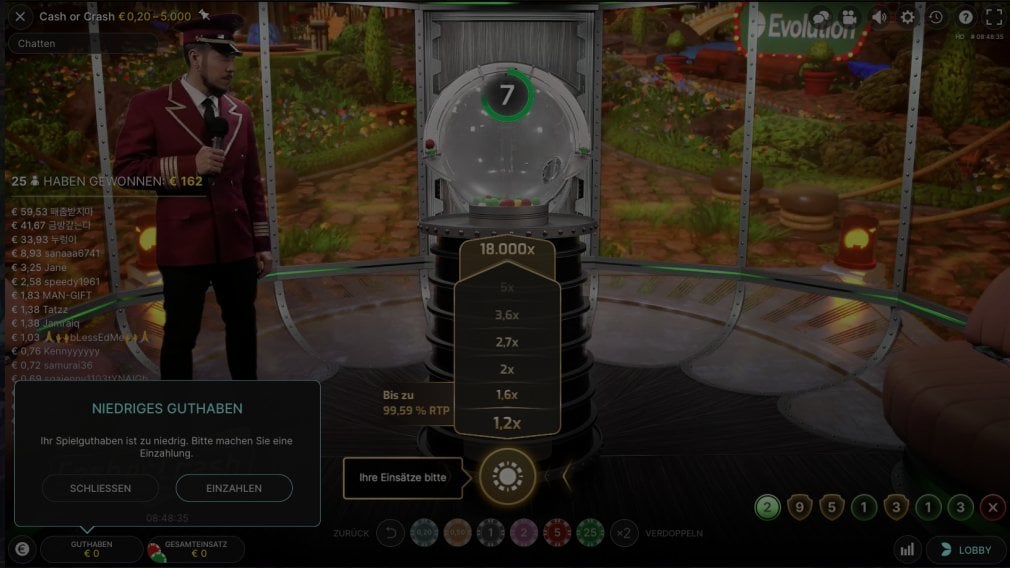
The live host is more than just talk. They set the game’s emotional pace. While they have no impact on the result, they expertly build suspense. They announce the climbing multiplier and provide live updates on what percentage of the crowd is cashing out at each level. That social cue can play tricks on your head. But remember, the host works separately from the game’s engine: the Random Number Generator (RNG). The crash point for each stage is established by a certified RNG the instant the stage begins. This guarantees fairness and total unpredictability. The host has no clue when the crash will happen. Their job is entertainment. The RNG’s job is certifiable fairness. This combination blends transparent live action with provably random results.
Statistical Basics and Volatility
Let’s examine the figures that drive the game https://cashorcrashcasino.com/. The multiplier for every round is based on a defined probability model. Frequent, small multipliers for instance 1.2x or 1.5x have a high probability of being chosen. Very large multipliers can occur, but are exponentially more improbable. This system maintains the game fair. The frequent, small crashes pay for the infrequent, massive possible wins. The RTP figure is a statistical percentage across millions of plays. In a single gaming session, the fluctuations are dramatic. You aren’t betting against the house in a standard manner. You are making decisions against a hidden, random number. Keep these key facts in mind:
- Separate Rounds: Every round’s crash point is an independent occurrence. A crash of 1.2x in round one gives no info about round two.
- No Predictable Sequences: The random number generator ensures no predictable sequences. Historical crashes or big wins do not influence what comes next.
- House Edge: The system incorporates a house advantage, which is shown in the publicly disclosed RTP from the provider.
Methodological Structures and Gambler Mindset
No strategy can defeat the fundamental randomness. But you can use structured methods to manage your bankroll and your feelings. The main conflict is a compromise. Do you guarantee fixed returns, or aim for exponential growth? Gamblers often use strategies like the “Fixed Cash-Out.” Here, you choose ahead of time to withdraw at a particular multiplier, say 2x, in every round. This aims for stable, small gains. The opposite is the “Let It Ride” method, where you risk several rounds for a opportunity for a huge reward, recognizing that failures will occur. A more strategic tactic is the “Percentage Bankroll” method, where you modify your stake based on your present profits. The most important element, though, is in your mind. Can you resist the “greed factor” when the ratio climbs? Can you avoid frustration after an premature loss? Your most powerful tool is creating firm guidelines for yourself before the rocket even begins.
Common Pitfalls to Evade
Be wary of a few typical blunders. The most damaging is “chasing” a failure. This signifies impulsively raising your stake after a loss, which goes against the process’s round-independent design. Another misstep is believing in the “hot hand” illusion, thinking a sequence of large ratios is likely to carry on. Allowing the commentator’s chatter or the moves of other participants distract you from your own pre-set plan is common. Also, do not misunderstand the zones. The Amber and Red Zones aren’t challenges to conquer. They are signals that the hazard has increased. Entering any phase without a defined objective converts the activity from a process of judgment into a sheer emotional ride. That experience seldom finishes well.
Conclusion: A Orchestration of Luck and Decision
Cash or Crash Live is a captivating combination of absolute fortune and conscious selection. Its structure are built to weave a narrative of increasing stakes, fueled by a transparent RNG and livened by a engaging presenter. Defining victory as a fun and possibly rewarding game depends on various elements. It’s less concerned with predicting the unpredictable and instead about grasping how the game is designed. It requires managing your bankroll with discipline and curbing the emotional inclinations the game masterfully triggers. By mastering its phases, respecting its mathematical structure, and adhering to a custom strategy, you can transform your outlook. You move from confused guesswork to informed participation in a remarkably thrilling live game show.
Recent Comments